


On Jan. 13, on a 4-1 vote (Commissioner Walt Benson voting no) the Bernalillo County Board of Commissioners approved, for introduction, a resolution sponsored by Commissioner Eric Olivas that raises strong concerns among the business community. In short, the resolution seeks to impose “guidelines” for construction of data centers so stringent that it very well could amount to a ban on data center construction in the county. From comments made by the advocates of the resolution, it’s pretty clear that data centers are unwelcome because the advocates believe that there is little if any “net community benefit.”
Olivas asserted that data centers use too much water and electricity and do not provide enough permanent well-paying jobs. In response to these concerns, the resolution seeks to require any application for economic development funds, such as industrial revenue bonds, be conditioned on replacement water supplies, total use of renewable energy, no impact on electric rates (requiring a separate micro-grid and utility contract) and worker salaries of at least $75,000 per year or 160% of median income whichever is higher. In our view, the likely outcome is that those wishing to construct a data center will simply avoid Bernalillo County and go where they are welcomed. This may be the very outcome desired by the advocates but rest assured that we will work with the Commission to ensure a balanced approach that produces overall community benefit including the investment of millions of dollars, high paying jobs that data centers can bring and large scale computing capacity so necessary to a modern 21st century economy.
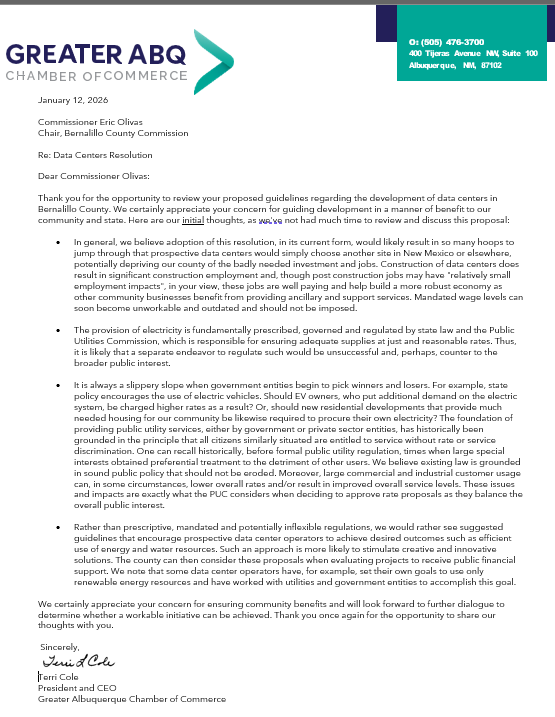
The Commission is set to consider adoption of the resolution at its next meeting on January 28. Terri Cole, president and CEO of the Greater Albuquerque Chamber of Commerce, sent a letter Monday (see below) to the Commission laying out business’ preliminary concerns with the measure. The resolution was only made available on Monday for review and comment. “This is a very slippery slope,” Cole said. “We all know from experience that inflexible government rules and regulations stifle creativity and innovation, often producing a host of negative, unintended consequences.”
Cole observed that the government essentially picking “winners and losers” has proven to be a poor strategy. She raises the question of what’s next? Should new housing developments be held to these same standards even though there is a critical housing shortage? Should electric vehicle owners be required to pay separately for charging their cars? “The answer isn’t to play the ‘not in my backyard’ card but rather to look for ways to both encourage development and enhance community benefits,” observed Cole.